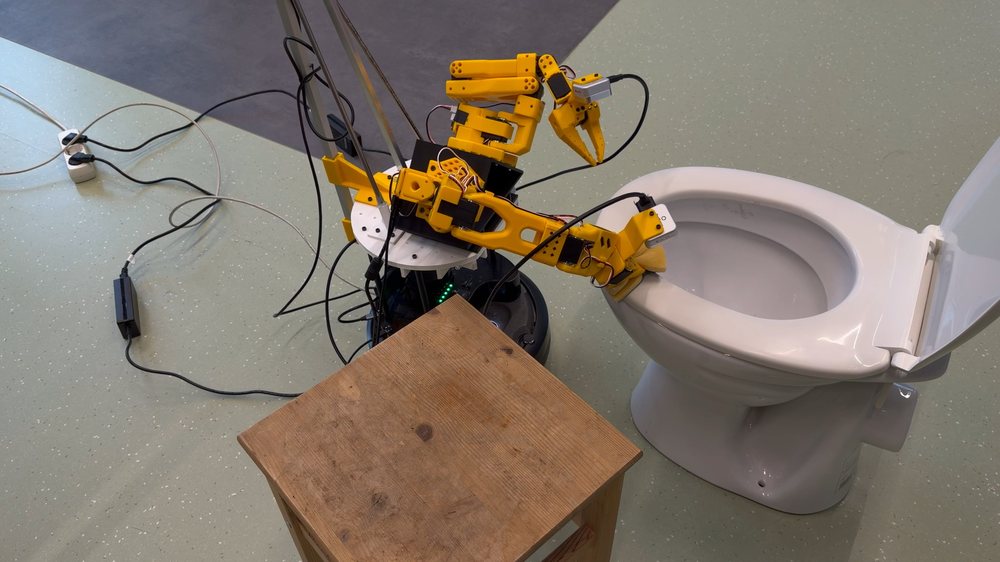
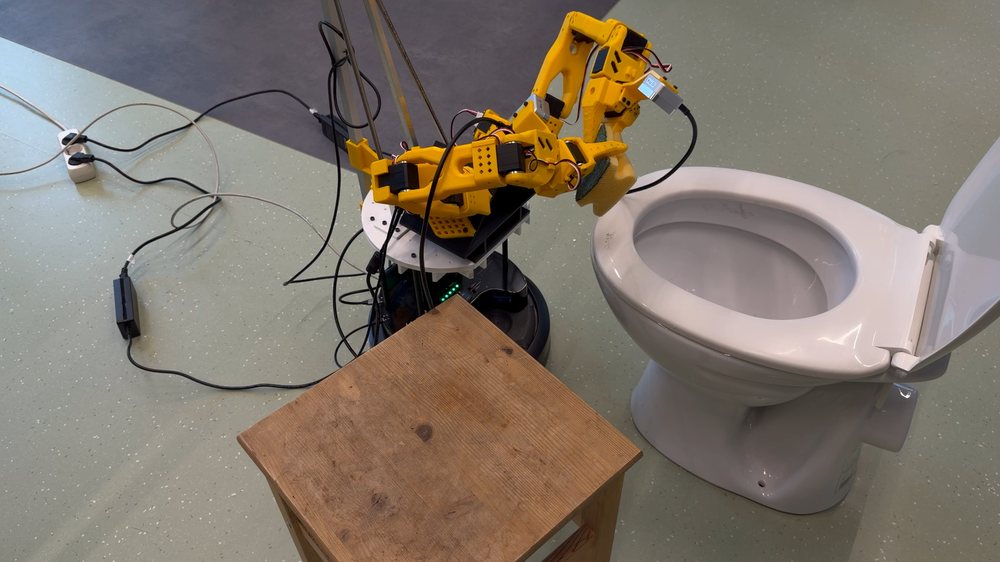
Two LeRobot SO-101 arms on a TurtleBot 4. 250 real-world demonstrations. Four open VLA models evaluated under one embodiment, one dataset, one set of physical conditions.
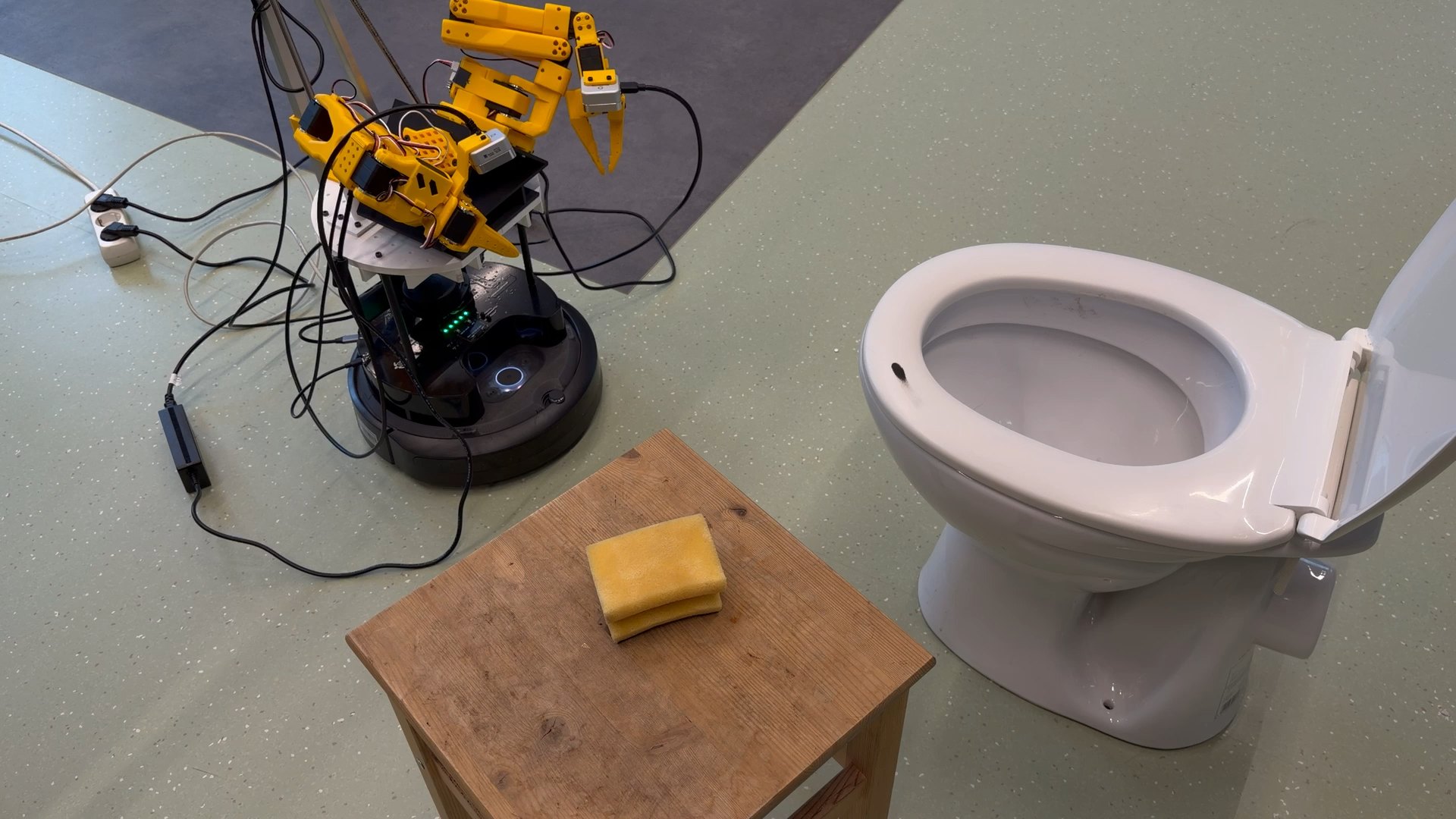
The platform at episode start
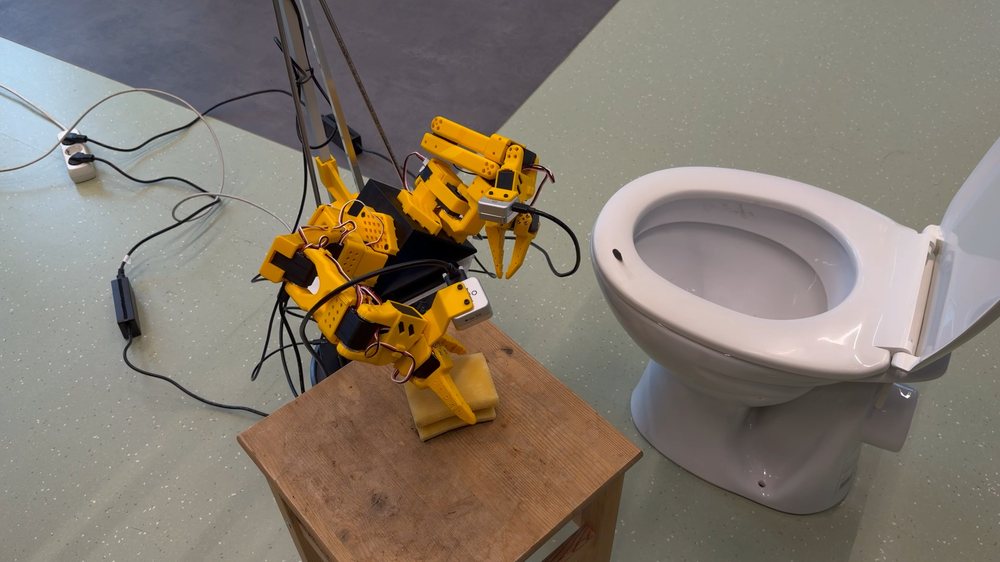
Vision-language-action models have shown promising capabilities for robot manipulation, but their performance on accessible mobile bimanual platforms remains underexplored.
We present a low-cost and reproducible mobile bimanual platform integrating two LeRobot SO-101 manipulators with a TurtleBot 4 and a LeRobot–ROS 2 software stack. Using long-horizon toilet cleaning as a case study, we collect 250 real-world demonstrations and evaluate π₀, π₀.₅, SmolVLA and GR00T under the same embodiment and task conditions. We further evaluate variants using SARM-derived task-progress signals and short-term MEM observation history.
Among the evaluated models, π₀ performs best, achieving 60% strict and 70% relaxed autonomous success, increasing to 90% with limited human intervention. In contrast, the evaluated progress- and memory-augmented variants do not improve their corresponding baselines. Our results demonstrate the feasibility of long-horizon mobile bimanual manipulation on accessible hardware while highlighting remaining challenges in reliable VLA deployment.
This work contributes a testbed, not a new policy architecture. Every model is fine-tuned from its public LeRobot implementation on the same 250 episodes and run on the same robot, in the same room, against the same randomization.
An uncut autonomous rollout: approach, grasp, scrub, bimanual flip, wipe, return. No teleoperation, no stage triggers.
The platform is built exclusively from off-the-shelf hardware plus additively manufactured parts, so the whole robot can be reproduced from the repository and a spool of filament. A redesigned TurtleBot 4 top cover keeps the original mounting interfaces while adding holes for the custom assembly; a triangular base above it carries both SO-101 arms while reducing workspace interference between them.
Six joints per arm, absolute joint-position actions. Leader-arm teleoperation with torque control and force feedback, so a human can take over mid-rollout.
Linear and angular base velocity enter the action space alongside the arms, making navigation part of the policy rather than a separate controller.
Two wrist-mounted RealSense D405 cameras plus a D435 head camera on a 15 × 15 × 1000 mm aluminium tube, braced by printed supports to suppress oscillation while driving.
A Zenoh–ROS 2 bridge carries observations to the workstation and whole-robot actions back. Heavy policy inference runs off-board; the onboard computer handles real-time hardware I/O.
Nine custom components make up the mechanical assembly. Print statistics below are for the complete set.
| Component | Role |
|---|---|
| Redesigned top cover | Foundation of the upper assembly; preserves TurtleBot 4 interfaces |
| Triangular base | Carries both SO-101 arms, reduces inter-arm workspace interference |
| Shark tail | Rear structural extension of the top cover |
| D435 neck / support tube mount | Holds the 15 × 15 × 1000 mm aluminium camera mast |
| Upper support holder | Upper brace between mast and cover |
| Lower support holder | Lower brace between mast and cover |
| Front support | Forward stiffening member |
| Side supports (× 2) | Lateral stiffening, suppresses camera oscillation |
| Support base | Load path from mast assembly into the cover |
| Complete set | 71 h 53 min · 268.73 m filament · €22.50 |
The robot removes a dirt smudge from a toilet seat using both sides of a sponge taken from an adjacent table. The decomposition below is used for annotation and analysis — the policies receive a single task description, not per-stage commands.


Stage 3 is the reason the task needs two arms: the sponge flip is the only subtask that cannot be completed unimanually.
Recorded at 30 Hz with the LeRobot recording scripts into a standard LeRobot dataset. Each frame carries wrist and head camera images; the state is both arms' joint positions plus base linear and angular velocity. Actions are taken from the leader arm's joint configuration, absolute by default.
| Split | Episodes | Typical length | Collection mode |
|---|---|---|---|
| Teleoperation | 200 | ~1.2 min | Full leader-arm teleoperation |
| Correction | 50 | ~2.0 min | Human-in-the-loop takeover (DAgger-style) |
| Total | 250 | — | 30 Hz · manual substage annotation |
The 50 correction episodes matter more than their count suggests: they are collected by taking control back from a running policy, so the dataset contains recoveries from the out-of-distribution states that policies actually reach.
Twenty rollouts per policy (GR00T: five, all failed). Strict means no dirt remains. Relaxed allows faint residue that is invisible to the cameras. With intervention counts rollouts where a human only freed a physically stuck robot and returned it to a in-distribution pose, without otherwise driving the task.
π₀.₅ underperforms π₀ here. Only the flow-matching action head of π₀.₅ is public — the high-level subtask prediction and action tokenization are not released — so what we evaluate is the low-level half of the model. Our experiments cannot isolate whether that gap explains the difference.
Both augmented variants fall below their baselines. Feeding additional state of unknown reliability during fine-tuning appears to hinder rather than help, though we cannot pin down a concrete cause.
SmolVLA, trained largely on community fixed-base SO-arm data, mostly failed to even approach the sponge. GR00T, aimed at humanoid embodiments, could not reliably pick it up. Neither had seen a mobile bimanual embodiment like this one.
For π₀, freeing a stuck robot lifts success from 70% to 90%. For π₀.₅ the same intervention never produced a completion: once it lost the sponge or missed the spot, the rollout was unrecoverable.
Failures cluster in embodiment adaptation, stage transitions and out-of-distribution recovery — not in the individual motor skills. Grasping and scrubbing were largely solved; knowing when to stop scrubbing was not.
@inproceedings{anonymous2027mobilebimanual,
title = {Low-Cost Mobile Bimanual Manipulation for Long-Horizon
Toilet Cleaning},
author = {Anonymous},
booktitle = {Under review},
year = {2027},
note = {Author names withheld for double-blind review}
}